
Why Regular Audi Logbook Servicing Is Non-Negotiable for Brisbane Owners
Three reasons. Performance, fuel efficiency, and long-term reliability.
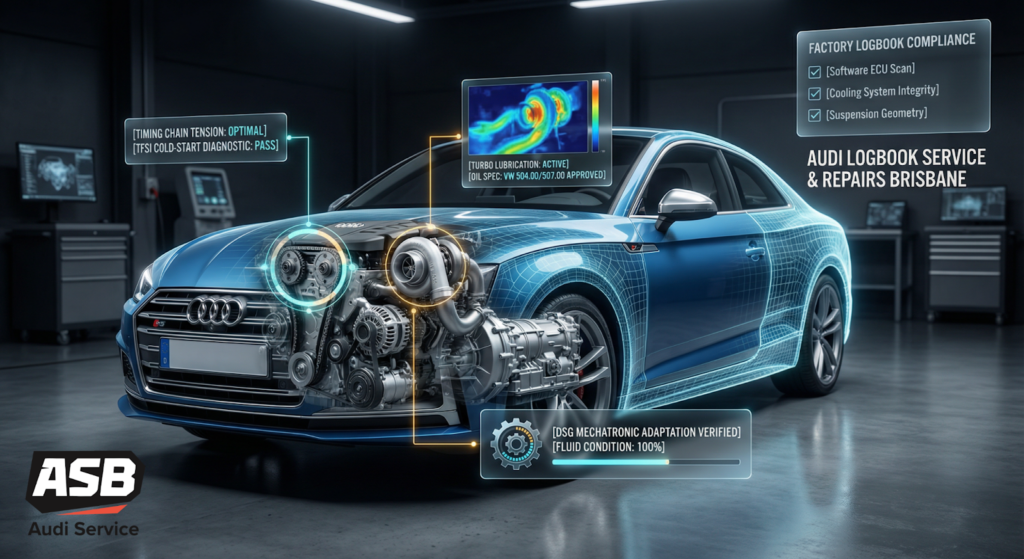
Turbocharged engines and dual-clutch transmissions degrade measurably without correct fluid maintenance. A properly maintained engine operates at designed combustion efficiency – a neglected one doesn’t. And catching a developing fault during a scheduled service costs a fraction of what that same fault costs at failure point.
A logbook service is not a generic “service.” It follows Audi’s defined schedule for your specific model and engine type – checklists, fluid specifications, torque values, and inspection sequences drawn from factory documentation. The cost is predictable, transparent, and always lower than the faults it prevents.
What a Proper Audi Logbook Service Includes – A Model-Specific Checklist
Six core elements make up every compliant Audi logbook service:
- Engine oil and filter to manufacturer-approved specification
- Brake system condition assessment and wear measurement
- Cooling system and water pump inspection
- Suspension and steering component evaluation
- DSG or S tronic transmission condition check
- Full software update and fault code scan across all accessible ECU modules
The scope is model-specific and engine-specific. An Audi A4 2.0 TFSI on a minor interval receives a different inspection than an Audi Q7 3.0 TDI due for a major. The factory schedule dictates scope – not workshop preference.
Every service concludes with a logbook stamp, odometer reading, and detailed digital records. Your warranty is protected. Your resale value is preserved.
Engine Oil & Filter Service – Why Turbocharged Audi Engines Are Unforgiving of Shortcuts
The turbocharger bearing shaft operates at extreme rotational speeds. Engine oil is its only lubrication and cooling source. Degraded oil, incorrect viscosity, or extended drain intervals cause bearing wear that progresses silently – right up until catastrophic failure.
Correct Audi oil servicing means manufacturer-approved grades meeting VW Longlife specifications – 504.00/507.00 for petrol, 507.00 for diesel depending on the engine – OEM-compatible filters, and a proper service interval reset via diagnostic software. Not just a physical oil change.
Brisbane compounds the problem. Short inner-city trips prevent the engine reaching full operating temperature. Stop-start traffic keeps load cycles low. Queensland summer heat places additional thermal demand on lubricants. Getting the oil grade wrong on a TFSI engine is not a minor oversight – it’s a turbocharger warranty claim waiting to happen.
Brake System Inspection During Your Audi Logbook Service – What Gets Checked and Why
A thorough brake inspection covers: pad thickness against minimum specification, rotor surface condition and lateral runout, brake fluid moisture contamination check, electronic wear sensor functionality, and caliper operation including slide pin condition.
Brake fluid is the detail most workshops skip. Moisture contamination lowers the fluid’s boiling point – under sustained heavy braking, that causes fade at exactly the moment full stopping power is needed.
Brisbane’s stop-start traffic accelerates wear across all Audi models. Heavier Q-series SUVs feel this most – the Q5, Q7, and Q8 carry significantly more kinetic energy at city speeds, placing greater thermal load on brake components with every stop. Gradual wear reduces braking efficiency silently. By the time a warning light appears, the rotor may already be scored.
Cooling System & DSG Transmission Checks – The Two Logbook Items That Prevent Costly Failures
The cooling system inspection covers water pump condition and bearing play, coolant concentration, radiator and hose integrity, thermostat operation, and – for turbocharged models – intercooler and turbo cooling circuit condition. Queensland’s summer heat places sustained demand on Audi cooling systems that owners in cooler climates simply don’t experience.
DSG and S tronic transmission condition is assessed as a standard logbook item: fluid condition and level, mechatronic adaptation check via diagnostic software, and any shift quality irregularities that signal developing faults. Catching these at a scheduled service prevents them from becoming a mechatronic replacement conversation.
Cooling system failure and DSG failure are among the most expensive Audi repairs. Both are almost entirely preventable with correct, timely servicing. These are not optional inspection items.
Audi Warning Lights & Unusual Noises – Why Early Diagnosis Always Saves Money
A warning light or unfamiliar noise in an Audi is rarely an isolated fault. Modern Audi vehicles have deeply integrated electronic and mechanical systems – one failing component places stress on adjacent systems. A fault that costs $400 to fix today may cost $1,500 in three months if left uninvestigated.
European-specific diagnostic equipment accesses all ECU modules simultaneously, reads live data streams, and identifies fault codes with freeze-frame context. This reveals not just what has triggered, but why – enabling root cause identification rather than speculative part replacement.
And sometimes there’s no warning light at all. Subtle changes in throttle response, gear engagement quality, steering feel, or ride quality are early indicators. An Audi that’s “not driving the way it should” is communicating something. Experienced Audi technicians can interpret it.
Common Audi Repairs in Brisbane – The Faults We Diagnose and Fix Most Often
Seven repair categories come through the workshop most frequently:
- Timing chain inspection and replacement – progressive wear that announces itself with a cold-start rattle
- Oil consumption investigation – quantified, traced to source, not dismissed as “normal”
- DSG and S tronic fault diagnosis and repair – from shift quality irregularities to mechatronic assessment
- Turbocharger performance assessment and replacement – often the downstream consequence of incorrect oil maintenance
- Cooling system leak identification and repair – caught early, inexpensive; left late, engine-threatening
- Engine management and EPC warning light investigation – root cause diagnosis, not code clearing
- Suspension and control arm wear assessment – geometry, tyre wear, and drivetrain impact addressed together
Every repair begins with accurate diagnosis. Parts are never replaced speculatively. Fault codes are never cleared without identifying what generated them.
Audi Timing Chain & Oil Consumption – Brisbane’s Two Most Misunderstood Audi Problems
Certain Audi TFSI engines have a known timing chain tensioner wear pattern. The symptom: a cold-start rattle that disappears within seconds of start-up. Easy to dismiss. Not minor. It indicates a tensioner failing to maintain correct chain tension under cold oil pressure – and the eventual consequence is engine damage that could have been prevented for a fraction of the repair cost.
Oil consumption is separate. Some Audi TFSI engines consume oil between service intervals – this is a known characteristic in certain model years and requires monitoring, not ignoring. An engine that drops below minimum oil level causes turbocharger and bearing lubrication failure. Regular oil level checks between services are essential, not optional.
Both issues require proper diagnosis before any repair is proposed. Chain wear is measured. Oil consumption is quantified and traced to source. Nothing is assumed. Nothing is prescribed without data.
Audi Suspension & Control Arm Repairs in Brisbane – Handling, Safety & Tyre Wear Explained
Audi’s quattro drivetrain and sport-tuned suspension are calibrated to specific geometry tolerances. Worn control arms, bushings, or ball joints shift wheel geometry out of specification – degrading steering precision, tyre contact patch, and torque distribution in AWD variants simultaneously.
The symptoms: clunking over Brisbane’s rough road surfaces, uneven tyre wear across the tread width, pulling to one side under neutral driving, or a steering feel that has become gradually vaguer. Each points somewhere specific.
Audi suspension repairs require the full sequence – not just new parts. Aluminium control arms and subframe components need specific handling procedures, torque angle specifications, and post-replacement wheel alignment to restore correct geometry. New parts without the full procedure leaves the geometry wrong. The fix isn’t complete until the alignment is correct.
Book Your Audi Logbook Service or Repair in Brisbane – Specialist Care From First Inspection to Final Check
Two types of Audi owners read this page.
The first has a scheduled logbook service due and wants certainty that factory specifications will be followed correctly and documented properly. The second has a current concern – warning light, unfamiliar noise, a change in how the car drives – and needs an accurate root cause diagnosis and a clear, honest repair recommendation.
Both are served here. When you book, have your model, year, approximate mileage, last service date, and any current symptoms ready. Not sure whether you need a logbook service, a diagnostic check, or a specific repair? The team will advise – one contact resolves the uncertainty.
Every service and repair begins with correct diagnosis, proceeds with approved parts and factory procedures, and concludes with full documentation. You leave with a properly serviced, correctly recorded Audi and complete peace of mind.
Book your Audi logbook service or diagnostic check in Brisbane – root cause diagnosis, transparent pricing, no unnecessary repairs.
